Survivor, doctor warn of rising endometrial cancer rates among younger women
OMAHA, Neb. (InvestigateTV) - The biggest overall risk of developing cancer comes later in life, as the typical age for a diagnosis is 67 years old.
But recent data shows a growing number of young people are receiving the life-changing news. Researchers at the National Institutes of Health found between 2010 and 2019 the incidence of fourteen cancer types increased among people under 50.
One of those is uterine cancer, which also saw an increase in death rates at younger ages. Most uterine cancers happen in the endometrium, the inner lining of the uterus.
A life-changing diagnosis
Amy Nissen said her first symptom appeared in March 2024 — abnormal vaginal bleeding.
“It was the heaviest vaginal bleeding I’d ever had in my entire life,” Nissen said. “I could never get ahead of it. I could never get it under control. I had been having my period for 30-some years and never had to take a change of clothes to work, and now I was having to take a change of clothes.”
Nissen said she searched the internet for answers but found most references to endometrial cancer focused on post-menopausal women over 60, which led her to dismiss the possibility.
“It was one of those things that I was so embarrassed about it,” she said. “I didn’t really bring it up to anybody.”
The bleeding eventually brought her to the emergency room, and soon after, a diagnosis.
She would find out a day before her 43rd birthday that she had endometrial cancer.
“I wasn’t really grasping it yet,” Nissen said. “It was still such a shock.”
Rates rising among younger women
Endometrial cancer rates are increasing nationally. According to pharmaceutical company GSK, more than 160 women are diagnosed every day. GSK estimates 62,000 cases were diagnosed and 12,500 deaths resulted from the disease in 2025, making it the most common form of gynecologic cancer in America.
Dr. Lindsey McAlarnen, a gynecologic oncologist at Nebraska Medicine, said more women in their 20s, 30s and 40s are receiving this diagnosis. She said growing rates of obesity are a contributing factor.
“We see that obesity in general is a risk factor for uterine cancer, but it’s also a risk factor for uterine cancer coming back or recurrence,” McAlarnen said. “Really living a healthy lifestyle and being at a healthy weight is beneficial for all of our patients.”
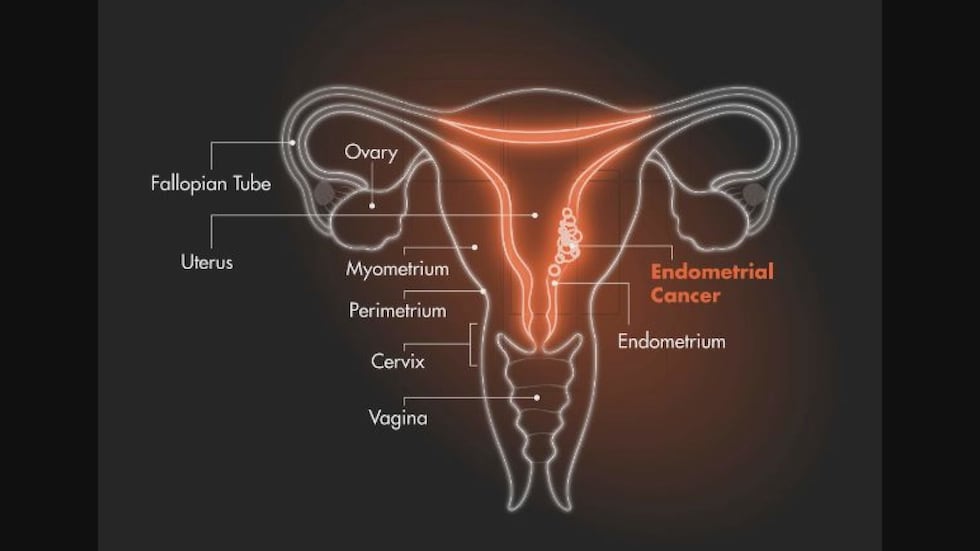
McAlarnen said abnormal bleeding is the key warning sign women should not ignore.
“Either heavy bleeding or in somebody who has gone through menopause and stopped having periods, any type of bleeding that shows up after they’ve had no bleeding for a year, that’s a reason to see your doctor or provider, because it could be a cancer growing in the lining of the uterus,” she said.
Additional symptoms of endometrial cancer include new or unusual discharge and persistent pelvic pain.
McAlarnen said survival rates exceed 95% when the cancer is caught at stage one, but drop sharply if it spreads.
“I’ve seen too many older women who thought that getting a period again was normal or who thought that having a little bit of spotting with wiping wasn’t something to worry about,” she said. “And then if you leave it untreated for even a year, cancer can spread and that can really impact your chances of survival.”
Treatment and recovery
Nissen was diagnosed early and no chemotherapy was required.
“I opted for a total hysterectomy,” Nissen said. “I know that’s not the choice for all women. It was what was right for me and where I was in life.”
The procedure is a minimally invasive robotic surgery performed by a doctor, completed in a couple of hours, with patients typically able to go home the same day.
Nissen said she is doing well since the surgery and goes in for regular monitoring.
Nissen and McAlarnen are partnering on GSK’s “Don’t Be Embarrassed” campaign to encourage women to speak openly with their doctors about symptoms.
“The more conversations we can have, the more it chips away at that stigma,” Nissen said. “Somebody maybe if they’re hearing my story will go, hey, I haven’t been talking about it but I have something really similar to this going on. I should go get that checked out. Because it can change your life and it could even save your life if you go to your doctor.”
“Don’t be afraid to come in and start that conversation,” McAlarnen said.
McAlarnen also cautioned women against taking hormones — including pills or topical products — without first consulting a doctor, warning that excess hormones can lead to endometrial cancer.
Copyright 2026 Gray Media Group, Inc. All rights reserved.